“Building foundations for the future”
At Bishop Alexander, we believe all children should have the opportunity to reach their highest potential, regardless of their starting points. We prioritise the safety and well-being of our children and provide a safe, stimulating and nurturing environment for children to achieve their best academically, emotionally, socially and physically.
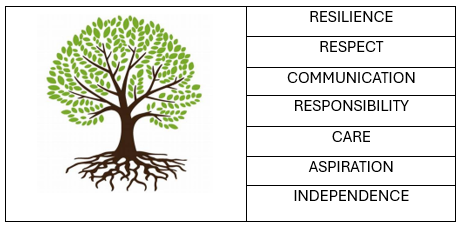
We know how important early years is for all children and that it is such a special time for young children to learn, develop and grow at the beginning of their life. We know that our early years is a safe space to build the foundations for our children to develop our school values:
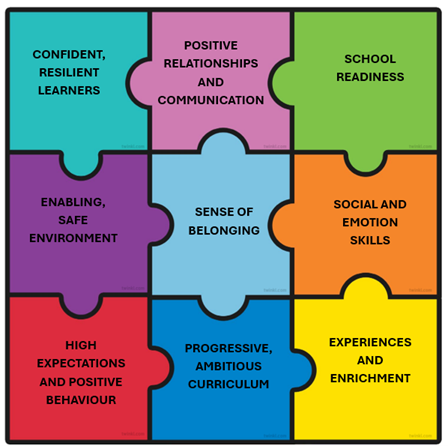
Our learning experiences enable children to become resilient, independent learners through an inclusive and ambitious curriculum offer.
We prioritise building positive relationships to ensure children feel safe, nurtured and a sense of belonging. Our priority is to develop social and emotional skills and focus on providing a language-rich environment with high quality interactions, including the importance of teaching the children to read and write.
Our learning environment provides opportunities for children to develop key knowledge and skills, igniting their curiosity, confidence and individual competency to flourish. We focus on the characteristics of effective learning to ensure the engagement, motivation and thinking of children.
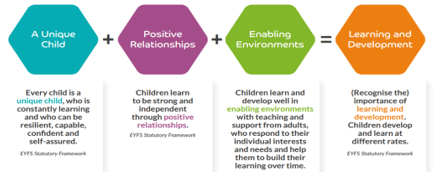
There are seven areas of learning and development that shape our curriculum and environment. All areas of learning and development are important and inter-connected. None of the areas of learning can be delivered in isolation from the others. Our children’s learning experiences enable them to develop competency and skill across several learning areas. They require a balance of adult led and child-initiated activities for most children to reach the levels required at the end of Early Years Foundation Stage (EYFS).
Three areas are particularly crucial for igniting children’s curiosity and enthusiasm for learning, and for building their capacity to learn, form relationships and thrive. These areas are the foundation knowledge and skills children need which need to be explicitly taught:
Staff will also support children in four specific areas, through which the three prime areas are strengthened and applied. These specific areas support children to develop key knowledge and skills in areas such as reading, writing, mathematical thinking, curiosity, creativity and the world around them:
We have used the areas of learning to carefully design and structure a thematic curriculum, to inspire and ignite our children. Each half term has a focus topic concentrating on what we want the children to know, understand and how this can be applied. All subjects are prioritised and progressive, and cross-curricular links are made. Our reception curriculum works alongside the school to feel the sense of excitement and belonging.
Our learning environment is child-centred, focussing on high quality interactions, sustained shared thinking and physical challenge. The inside and outside environment is designed to allow children to make independent choices, take risks and build on their prior learning. The aim of our environment is that all children can feel a sense of belonging. Children grow their independence, responsibility and resilience when accessing the environment through tidy up time, resolving conflict and having a go at something new.
In Reception, the children are taught through an approach which meets the needs of the cohort. We focus on the characteristics of effective teaching and learning which are embedded into our daily practice. The characteristics highlight the importance of a child’s attitude to learning and their ability to play, explore and think critically about the world around them:
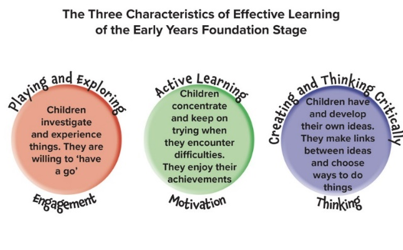
These areas support children to engage in place and learning, build curiosity, take risks and build confidence and independence. All these skills support the foundations that children need to continue their journey into Year 1.
Children in reception have a balanced diet of child-initiated activities and adult-led activities and teaching. Through our curriculum, we ensure children are exposed to practical experiences that bring excitement to learning and support cultural capital. We ensure teaching is of the highest quality, enabling our children to succeed and be motivated to learn. Some aspects of the curriculum are explicitly taught, with the idea that children will apply these skills into their independent learning.
When children join Bishop Alexander, we want them to feel happy, safe and settled in their new school. We spend time building relationships, developing social skills and getting to know the children and their interests. This supports staff to recognise the needs of the children and the need for early intervention.
Children’s development levels are assessed termly at assessment points and as the year progresses, the balance will shift towards a more equal focus on all areas of learning, as children grow in confidence and ability within the three prime areas. However, if a child’s progress in any of the prime areas gives cause for concern, staff will discuss this with the child’s parent/carer and agree how to support the child. Staff are quick at early identification of additional needs and ensure appropriate advice and support is accessed and put into place.
Informing parents/carers is important and staff will share school experiences with parents/carers. Learning profiles will be created through Marvellous Me and class floor book.
Reception also completes the Reception Baseline Assessment (RBA) within the first 6 weeks of starting school. The RBA is a short assessment process, with interactive and practical activities using a range of simple resources and pictures. The assessment focuses on communication and language, early literacy and mathematical skills. This is a statutory process for all schools from September 2021.
It is crucial to build strong relationships with parents/cares and are committed to working in partnership. We offer an open-door policy and encourage open communication to ensure parents/carers are happy with their child’s education and teachers are kept up to date with information from home. We love to share learning from school and home.
Within reception we provide hands on practical experiences for children to learn and develop. We plan experiences to ignite and inspire the children and activities we know our children love. Some of these experiences may include making bread, going on a local walk, science experiences, planting and growing, sensory experiences and physical exploration.
We aim to enrich children termly through school trips and visits, providing opportunities as a cohort. The educational experiences provide children with engaging opportunities linked to their current learning and understanding of the world and supports developing transferable skills such as independence and confidence.
Children in reception will also learn about the world around them during our weekly Forest learning experiences. This includes talking about and observing the natural world, including plats and animals and developing knowledge on plants and animals around us.
Children will also take part in a P.E session to develop their gross motor skills.
Throughout the year we invite special people from the community into our classroom, linked to our learning. Visitors include people who help us, such as firefighters and police officers.
Story time is one of the most important parts of the day. We introduce and develop high quality books to grow a love for reading. We have valuable story time daily, in addition to our oral rehearsal of stories. We take reading beyond the classroom in areas such as the library, the garden and forest area. We work alongside other year groups and often take part in buddy reading. We aim for all our children to become great storytellers and develop their imagination!
Our vision is that all children leave reception happy, confident and resilient learners who have a love for learning. We thrive on helping children to be their best and “doing the right thing at the right time”.
We aim for all children to enter Year 1 well-equipped, with the foundational knowledge and skills for successful learning. Our aim is for all children to reach the early learning goal by the end of reception. achieving their highest potential, regardless of their starting points.
To ensure effective judgement on children we undertake on-going assessments to monitor the progress. We work on collecting evidence, through books and photographs. We assess children daily through regular conversations, questioning and observations.